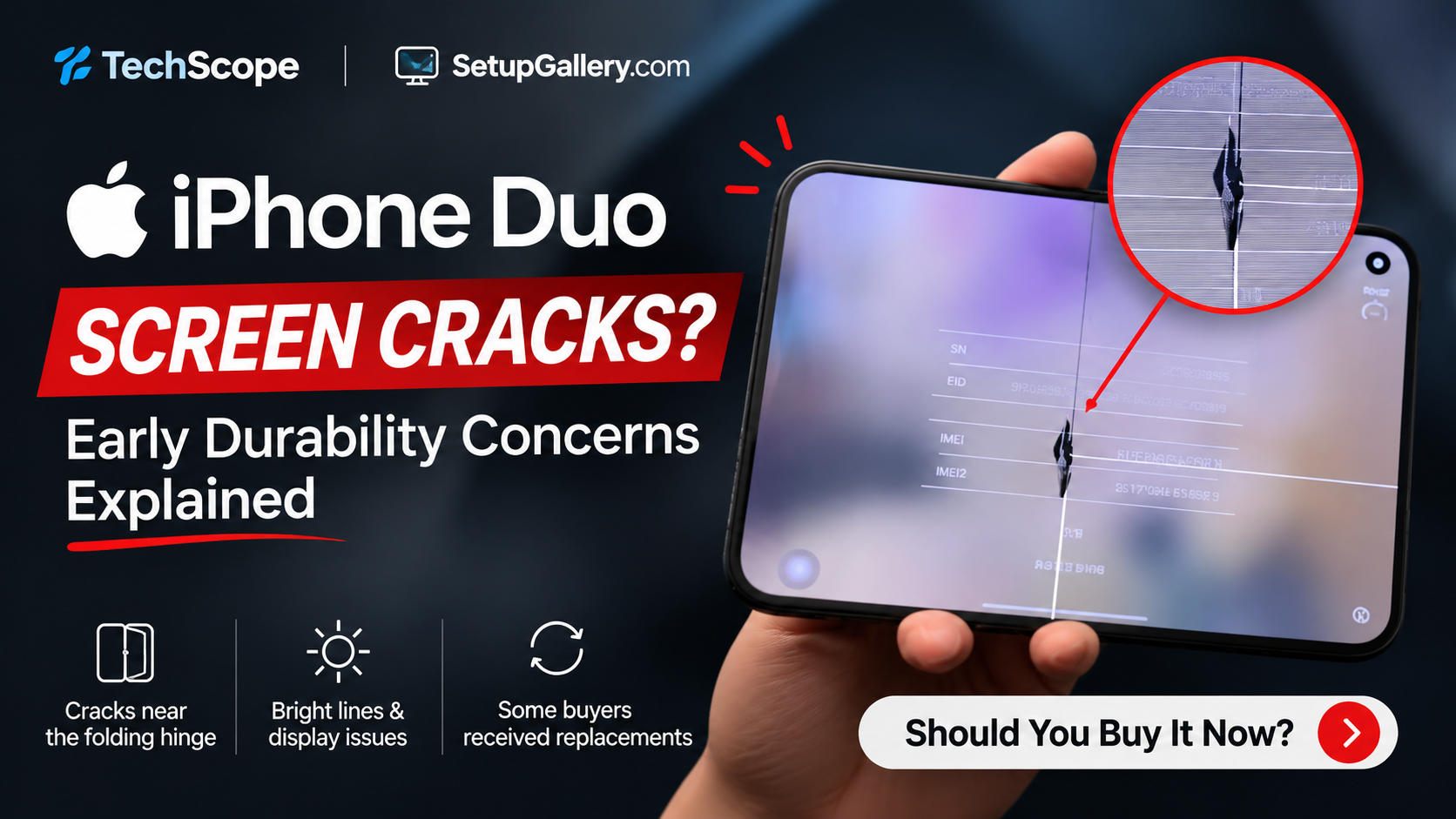
Apple's first foldable iPhone is already facing questions about its durability after some early buyers reported cracked inner displays just hours after receiving their devices. Images circulating online show damage around the central folding hinge, with some affected screens displaying unusual bright lines across the display.
The reports have sparked discussions about the reliability of Apple's new foldable smartphone, particularly among users considering spending a premium price on a device with a folding screen.
Although the reports are concerning, it is still too early to determine how widespread the problem is or whether all the affected devices share the same underlying cause.
What Is Happening to the Apple iPhone Duo?
The first reports of damaged iPhone Duo displays appeared shortly after the device went on sale on October 23, 2026.
Several users shared photographs of what appeared to be cracked inner displays on Reddit and the MacRumors forums. In many cases, the damage was concentrated along the central hinge, where the screen folds when the phone is opened or closed.
Some affected devices also showed bright lines across part of the display, suggesting that the problem may involve the screen's internal components as well as visible damage.
According to a report published by MacRumors, one buyer in Australia claimed that the phone's display cracked after approximately six hours of use and fewer than 20 openings. The customer reportedly felt something unusual around the internal hinge while opening the device, followed by an audible cracking sound. The device was subsequently replaced at an Apple Store.
However, the circumstances surrounding other reported cases vary, and the available evidence does not establish how frequently these failures occur.
Why Are iPhone Duo Screens Cracking?
The exact cause of the reported iPhone Duo screen failures has not been officially established. However, the location and appearance of the damage have raised questions about the relationship between the folding mechanism and the inner display.
1. Potential Hinge Mechanism Problems
A foldable smartphone relies on a complex hinge to support the display as it opens and closes. If a hinge component is misaligned or places excessive pressure on the display, it could potentially contribute to screen damage.
A teardown investigation published by iFixit on October 25 examined the device's internal construction and discussed several possible stress points around the hinge and display assembly.
2. Pressure on the Inner Display
Unlike a conventional smartphone, a foldable phone has a flexible internal display that must accommodate repeated bending. Pressure concentrated in a small area could potentially damage the display or its internal electrical connections.
A bright line on the screen does not necessarily mean the entire display panel has physically cracked — damage to internal connections can also produce visible display abnormalities.
3. Dust or Foreign Particles
Foldable phones face challenges involving dust and particles entering moving components. In its teardown, iFixit reported finding some dust inside the iPhone Duo's hinge and raised questions about whether particles could contribute to problems with the folding mechanism.
However, finding dust inside a device does not prove that it caused the reported screen failures.
Has Apple Responded to the Screen Problems?
As of October 26, 2026, Apple has not issued an official statement addressing the apparent display failures. MacRumors reported that at least one customer received a replacement device after taking the damaged phone to an Apple Store.
Anyone experiencing an unexpected crack or display malfunction should contact Apple Support or an authorised service provider rather than attempting to repair the folding mechanism independently.
Are the iPhone Duo Screen Problems Widespread?
This is the most important question, and there is not enough evidence to answer it confidently yet. The reported cases appeared shortly after the device's launch, and several photographs show damage in similar areas around the central hinge.
That pattern deserves attention, but social media reports alone cannot establish the overall failure rate. Until more reliable information becomes available, it would be premature to conclude that the iPhone Duo has a widespread design flaw.
Should You Buy the Apple iPhone Duo Right Now?
If you are considering Apple's first foldable iPhone, these early reports are worth monitoring before making a purchase. Here are four things to consider.
1. Wait for longer-term durability reviews — Early launch reports provide limited information. Independent testing and longer-term owner experiences should help clarify whether the reported failures are isolated incidents or part of a broader pattern.
2. Check the warranty and replacement policy — Before purchasing an expensive foldable phone, understand what Apple's warranty covers and how display damage is assessed.
3. Consider the cost of repairs — Foldable displays and hinge assemblies can be complicated and expensive to repair. Factor potential repair costs into your buying decision.
4. Compare other foldable smartphones — Consider competing foldable devices alongside conventional flagship smartphones. Compare their durability, software support, repair options, battery life, and overall price.
What This Means for Apple's Foldable iPhone
The iPhone Duo represents an important step into foldable smartphones for Apple, but the technology introduces engineering challenges that conventional phones do not face in the same way. Early reports of cracked screens do not prove that the product is fundamentally unreliable. Nevertheless, they highlight why durability testing and transparent warranty support are important for expensive devices with new designs.
Apple's response, future repair data, and independent testing will help determine whether these incidents represent isolated failures or a more significant issue.
*Reporting note: This article reflects information available on October 26, 2026. The cause and prevalence of the reported failures may become clearer as more devices are examined and additional information is published.*


